Currently Empty: $0

Professional Development Certificate
K-12 Teachers
4 hours session
CILL Certification
Overview
Inclusive Education Part 1: Five Tools to Help You Navigate introduces a practical framework for supporting learner diversity within whole-class teaching. The program challenges the idea that inclusion requires constant individualization and instead focuses on how many barriers to learning can be addressed through intentional design at a group level.
The workshop is structured around five tools that help teachers notice where learning becomes difficult, understand patterns of need across the class, and respond through flexible and strength-based approaches. Moments of disengagement, confusion, or behavioral difficulty are explored as signals that instructional demands may exceed learners’ current capacity, rather than as problems located within individual students.
Participants engage with classroom cases, guided discussion, and hands-on application of the tools to their own teaching contexts. The focus remains on maintaining shared learning goals while offering multiple ways for learners to access, engage with, and contribute to learning. By the end of the session, participants will have developed a clearer, more sustainable approach to inclusive practice. Inclusion is positioned as part of everyday instructional decision-making, supporting classrooms where difference is expected, planned for, and valued.
Please note: This workshop focuses on inclusive classroom design and group-level instructional decision-making. It is not a specialist training in identifying or supporting specific learning disabilities. The session does not cover diagnostic frameworks or targeted interventions for conditions such as dyslexia, ADHD, or autism spectrum conditions.
Intended Audience
This workshop is designed primarily for classroom teachers working in early years through high-school contexts. It is particularly relevant for teachers in diverse classrooms who are seeking practical, sustainable ways to support learner variability through everyday instructional design rather than individualized or ad hoc fixes.
The workshop will also be of value to learning support staff, coordinators, and school leaders who work closely with teachers and wish to strengthen their understanding of inclusive classroom practice. However, the focus remains firmly on teacher decision-making, classroom routines, and instructional strategies that support engagement, self-regulation, and belonging for all learners.
What Participants Acquire
By participating in this workshop, participants will:
● Develop a clear, shared language for understanding inclusion as instructional design rather than individual intervention.
● Gain practical tools to identify where learning barriers emerge from task demands, routines, or structures rather than learner deficits.
● Build confidence in recognizing patterns of learning need at a group level and using these insights to guide instructional decisions.
● Acquire flexible strategies that allow diverse learners to access shared learning goals without lowering expectations or isolating students.
● Learn to use strengths, emerging skills, and learner capabilities as active resources for engagement, participation, and collaboration.
● Leave with a coherent, sustainable stance on inclusive education that can be applied consistently across lessons, units, and classroom contexts.
Training Structure
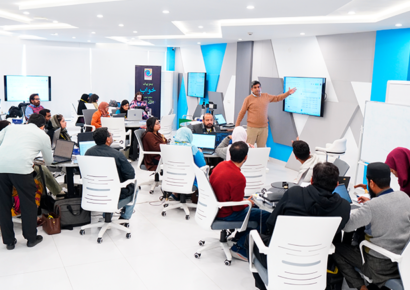
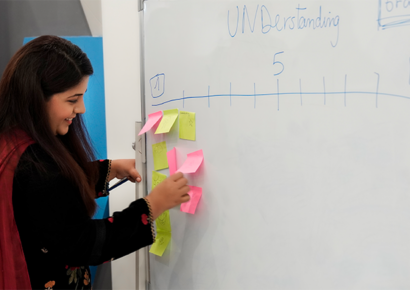
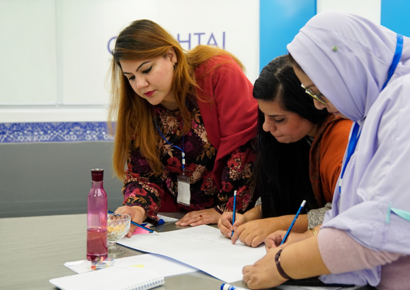
Hands-on learning experience:
✓ Exploring real classroom scenarios to surface common inclusion challenges
✓ Identifying critical situations where task demands exceed learner capacity
✓ Analyzing patterns of learning need at a group level rather than through individual labels
✓ Applying the five tools to design flexible pathways that support shared learning goals. Five tools used are as follows: Tool 1- Critical Situations, Tool 2- Identifying learning needs at a group level, Tool 3- Differentiation as flexibility, Tool 4- The Star of Skills, Tool 5- The Capability Pyramid
✓ Mapping learner strengths, skills, and capabilities to instructional design decisions
✓ Using the Capability Pyramid to make intentional choices about support, challenge, and independence
✓ Reflecting on inclusive practice as collective design and committing to one actionable shift in classroom practice