Currently Empty: $0

Professional Development Certificate
K-12 and HIgherEd educators
4 hours session
CILL Certification
Overview
AI in Education is a hands-on, practice-focused workshop designed to help educators understand, evaluate, and apply artificial intelligence tools in ways that enhance teaching, learning, and school operations without compromising professional judgment or ethical responsibility.
As AI tools become increasingly accessible, educators face both opportunity and risk. This workshop supports participants in moving beyond surface-level use toward thoughtful, pedagogy-driven integration. Participants explore how AI can support lesson design, assessment, differentiation, feedback, communication, and administrative efficiency, while remaining critically aware of limitations such as bias, accuracy, and over-reliance.
The workshop positions AI as a co-pilot, not a replacement for educator expertise. Through live demonstrations, structured prompting practice, and real-world classroom and school scenarios, participants build confidence in using AI to save time, deepen thinking, and support creativity, while retaining responsibility for learning design, student wellbeing, and educational values.
Emphasis is placed on critical evaluation, ethical decision-making, and practical transfer to participants’ own contexts. By the end of the session, educators leave with a clearer framework for when and how AI adds value, and when it should be used with caution or not at all.
Intended Audience
This workshop is designed for:
● Teachers across early years, primary, middle, and secondary levels
● Curriculum coordinators and instructional leaders
● School leaders and administrators involved in planning, communication, or data-informed decision-making
● Educators with little to moderate prior experience using AI tools who want practical, guided entry
● Experienced educators seeking to refine their use of AI through an ethical, pedagogy-first lens
What Participants Acquire
By participating in this workshop, educators will:
● Develop a clear, practical understanding of core executive function skills and their role in learning, behavior, and self-regulation in early years and primary classrooms.
● Gain insight into how executive function demands are embedded within everyday classroom routines, transitions, and learning experiences.
● Strengthen their ability to interpret challenging behaviors as indicators of developing or unmet skills rather than intentional misbehavior.
● Acquire practical, developmentally appropriate strategies that support focus, impulse control, emotional regulation, and planning in young learners.
● Build confidence in making small, intentional adjustments to classroom environments and adult responses to better support students’ self-regulation.
● Leave with at least one concrete strategy to implement immediately in their own classroom practice.
Training Structure
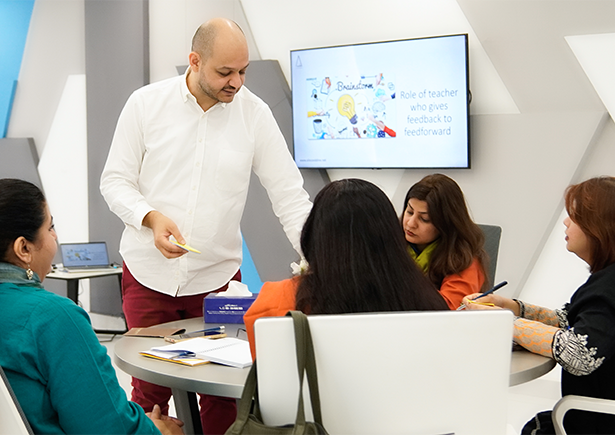
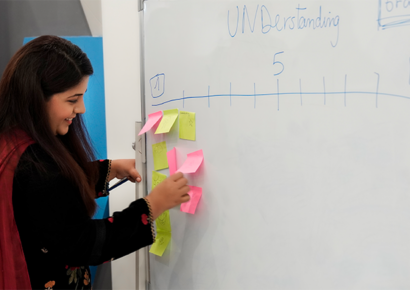
Hands-on learning experience:
✓ Brief grounding in what AI is (and is not) in educational contexts, using accessible, non-technical language
✓ Live demonstrations of selected AI tools relevant to teaching, assessment, feedback, and school communication
✓ Guided practice in writing, testing, and refining prompts for lesson planning, differentiation, and assessment support
✓ Small-group analysis of real classroom and school scenarios to decide when AI adds value and when it should be avoided
✓ Structured discussion on common risks, including bias, accuracy, over-reliance, and data privacy, using practical examples
✓ Application of responsible AI principles to everyday educator decisions and workflows
✓ Individual reflection to identify one or two AI-supported practices participants can realistically adopt in their own context
Impact and Alignment
By the end of this workshop, participants will be able to:
● Identify and evaluate at least three AI tools relevant to teaching, assessment, or school operations, selecting appropriate tools for specific educational contexts.
● Design and refine effective AI prompts to generate lesson ideas, assessments, or communication drafts aligned with learner needs.
● Analyze classroom and school-based scenarios to determine when AI use enhances learning and when it may pose ethical or pedagogical risks.
● Apply four key principles for responsible AI use to ensure fairness, accuracy, unbias and professional accountability in educational practice.